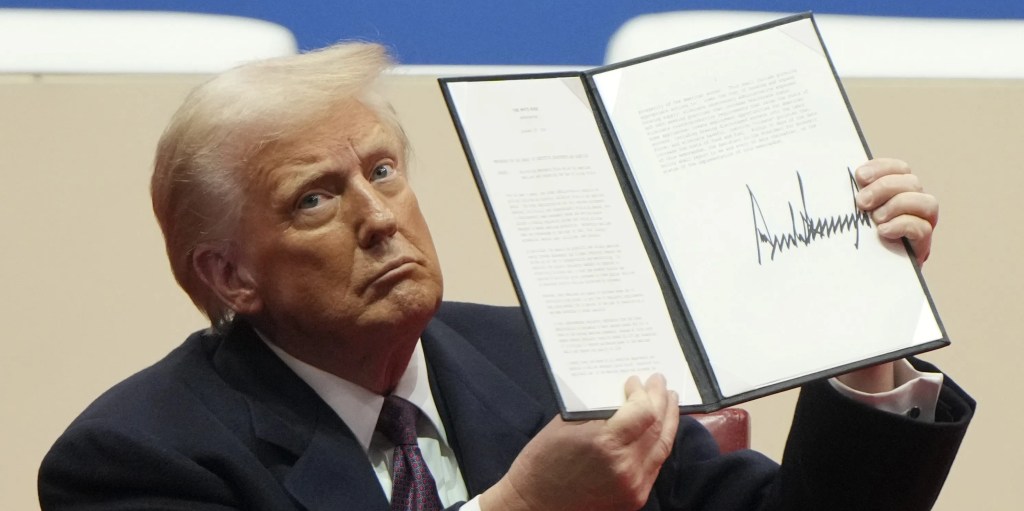


On January 20, 2025, Donald Trump passed an Executive Order (EO) titled “Defending Women from Gender Ideology Extremism and Restoring Biological Truth to the Federal Government.”
In this post, we’ll go over what changes were made, what comes next, and what our political takeaways are.
Table of Contents
What It Does
First and foremost: this EO pertains to the functioning of federal agencies. This means that it does not apply to anything that the federal government doesn’t control. State and local-level governments can maintain their own policies as well as private businesses.
Because of this, there are some protections in place in certain areas, like Ordinance No 9999 in Lawrence. More information on these protections are provided under each new policy as they apply.
Federal Definition of Sex & Gender
This EO provides an official definition of sex & gender for federal purposes. This definition:
- Asserts there are only two sexes: male and female,
- Defines “male” as a person whose assigned sex at birth produces “the small reproductive cell” (sperm),
- Defines “female” as a person whose assigned sex at birth produces “the large reproductive cell” (eggs),
- Declares birth sex to be unchangeable, and
- Views “gender” as a fake concept utilized to harm (cis) women.
New Policies
A number of new policies are now going into effect. These policies are divided into topics below.
Discrimination
Trans people are officially unprotected by Title VII and Title IX.
WHAT THIS MEANS:
- If you sue someone for refusing to hire you or firing you on the basis of being trans, you cannot use Title VII as an argument in that lawsuit.
- If you experience anti-trans discrimination in an educational setting or a location that receives federal funding, you cannot use Title IX as an argument in a lawsuit.
WHAT THIS DOESN’T MEAN:
- Some states have discrimination laws that protect trans people. In those states, trans people can use state laws in lawsuits.
- Kansas does not have discrimination laws that protect trans people. However, some cities do provide protection. Ordinance No 9999 in Lawrence — the ordinance that TLC created in 2023 — provides some protections for trans people within Lawrence. While it is not a perfect shield against transphobia, it does mean that the City of Lawrence specifically has made a commitment to not discriminating against trans residents or city employees.
- You can find a list of counties and cities in Kansas with discrimination laws that protect trans people at this link.
The Department of Labor (DOL), Equal Employment Opportunity Commission (EEOC), and all other agencies responsible for enforcing the Civil Rights Act must protect anyone accused of anti-trans discrimination.
WHAT THIS MEANS:
- Let’s say that you’re a trans woman who is harassed by a female coworker while using the women’s restroom. You take it to your boss and HR, but neither of them intervene. If you decide to complain to the EEOC about this, they will dismiss your complaint.
- On the flip slide, let’s say that, in this situation, your boss and HR respond to your complaint and reprimand your coworker. If that coworker decides to complain to the EEOC, your workplace could now face legal penalties.
- In short: anti-trans discrimination is no longer counted legally as discrimination, but protecting trans employees (etc.) against transphobia is counted as discrimination.
WHAT THIS DOESN’T MEAN:
- Again, this does not mean that you cannot make any complaint against discrimination, nor does it give free reign to transphobes. Applicable state/county/city laws & company policies still apply — granted that the transphobic employee in question does not bring federal agencies into it.
Documentation
Federal documents will reflect a person’s assigned sex at birth.
WHAT THIS MEANS:
- You will no longer be able to update your gender marker on your passport.
- It is likely that changes on Social Security cards will be banned as well.
WHAT’S UNCERTAIN:
- This EO is unclear on whether documents that have already been amended will be reverted back or not.
Federal employees’ personnel records will reflect their assigned sex at birth.
Funding & Healthcare
Federal funds cannot be used to “promote gender ideology.”
WHAT THIS MEANS:
- Anyone who receives federal funding — including non-profits, schools, hospitals — could potentially lose that funding based on openly acknowledging trans people and our needs.
- Loss of funding is a very serious threat for most service providers. In the absolute, worst case scenario, this could lead to something like a Hyde Amendment where hospitals and clinics would stop providing trans healthcare altogether.
WHAT’S UNCERTAIN:
- This policy is an incredibly vague one. We do not yet know how this will manifest. Do not catastrophize yet.
- It seems likely that all forms of federally-funded insurance — that is, Medicare and military-related insurance — will no longer cover trans healthcare. This could potentially impact any insurance plans bought through the Marketplace (aka, Obamacare).
- In the worst-case scenario, the only insurance plans that would cover trans healthcare are specific private insurance plans, specific employer-provided insurance plans, and Medicaid, depending on the state of residence. Kansas’ Medicaid plans do not cover trans healthcare.
The Secretary of Health and Human Services (HHS) must use the new federal definition of sex & gender and provide guidance on using this definition by February 19.
WHAT THIS DOESN’T MEAN:
- This does not ban trans healthcare. Again, do not catastrophize yet.
WHAT’S UNCERTAIN:
- Everything else. New guidance could make it significantly harder to find healthcare and/or have documents that reflect your health history and healthcare as a trans person. In any case, finding doctors who are knowledgeable about trans people — regardless of whether they advertise themselves as such or work specifically in trans healthcare — is more crucial than ever.
Sex-Segregated Institutions
Domestic & Sexual Violence Shelters
Women’s shelters will be permitted to refuse services to trans women & fems.
The Secretary of Housing and Urban Development (HUD) must create a policy that permits cis women to take action against a women’s shelter for providing services to trans women & fems.
WHAT THIS DOESN’T MEAN:
- Trans women & fems are not outright banned from women’s shelters. However, depending on the policy submitted by HUD, women’s shelters could potentially face legal action if a cis woman complains about a trans woman being in the shelter.
Correctional Facilities
Trans women & fems in federal detention centers will be housed with men — no exceptions.
Trans inmates in federal detention centers will not be permitted to receive hormones or gender-affirming surgeries.
Requirements for Federal Agencies
All federal agencies must adhere to the federal definition of sex & gender.
All federal agencies must remove any internal or external materials that acknowledge trans people.
All federal agencies must maintain sex-segregated spaces based on assigned sex at birth.
WHAT THIS MEANS:
- Let’s say that you are in the official headquarters for the Department of Transportation. If you are a trans woman and use the women’s restroom, you could be subject to some sort of punishment — such as removal from the building or banned from entering in the future — based on the agency’s policy.
WHAT THIS DOESN’T MEAN:
- This policy does not apply to anything but federal agencies.
- It does not make it illegal to use the bathroom, locker room, changing room, etc of your choice in general. This is a question about the policies of federal agencies — it is not a federal law that is applicable to all spaces.
WHAT’S UNCERTAIN
- What exactly those policies will look like, who it will impact, & how it will be enforced.
Repealed Executive Orders
Through this EO, Trump repealed five EOs that Biden signed during his term as president.
- Two provided protections from discrimination for all LGBTQ+ people.
- One permitted trans people to serve in the US military.
- One established the duty of federal agencies to expand the rights of LGBTQ+ and intersex individuals.
- One established the White House Gender Policy Council. While this council was more concerned with gender equality in general — that is, women’s rights — it did include trans identities as well.
WHAT THIS DOESN’T MEAN:
- While the EO does repeal other EOs that apply to all queer people, there are still some federal protections in place for cis queer people. However, we should continue monitoring these protections, as it’s not guaranteed that they will be left alone.
- Federal agencies are not mandated to work against the rights of cis queer & intersex people, but they are not obligated to work for them, either.
WHAT’S UNCERTAIN:
- The state of trans service members. They are not banned from the military yet, but it seems highly likely that a ban will occur in the very near future. This would likely impact any military-related benefits, including trans service members & veterans and any of their dependents losing access altogether.
Next Steps
The EO provides deadlines within the text for federal agencies to comply.
- By February 19, the definitions of male and female will be codified into a bill.
- By May 20, all federal agencies must update their policies & requirements to reflect this EO.
Can Anything Be Done?
Yes. The most likely option is that states that have pro-trans protections will take sections of this EO to court. However, there are two important things to remember:
- Taking the EO to court does not necessarily mean it will delay implementation. It could, but it’s not guaranteed.
- If someone takes this EO to court, it has to be in response to one specific section. For example, even if New York successfully sued the federal government over the section about employment discrimination, it would not reverse any other part of the EO.
Most importantly, the outcome of the court case ultimately depends on the judge hearing it.
The other option — and an outcome that we see frequently — is that the president that comes into office after Trump can undo this Executive Order.
Political Takeaways
Content warning for mention of sexual assault in prisons.
There are a few important things to note with this EO that we should keep centered as we continue fighting and strategizing.
Firstly: while all trans people are impacted by this, we must pay attention to the way the EO specifically frames the existence of trans people — and especially trans women & fems — as a threat to cis women in particular.
Secondly: the sex/gender distinction — that is, that your assigned sex at birth can differ from your gender identity — is specifically weaponized against trans people here. The focus on trans women & fems in this EO as inherently threatening to cis women is based on the premise that trans women & fems have a “male sex”.
In response to these two points, we must further an analysis of womanhood that is not based on identity alone but in understanding how women — both cis and trans — are defined and impacted by a misogynistic society. “Woman” is a socially constructed category, not a biologically innate reality. Focusing on biology and identity alone obscures all the ways in which trans women & fems are similarly oppressed to cis women, such as a substantially increased chance of experiencing sexual & intimate partner violence (1)(2)(3)(4), higher rates of poverty (1), higher rates of unemployment & lack of medical benefits at work (1)(2), the wage gap (1), and a lack of medical & bodily autonomy.
The fact that trans women are treated differently than cis women does not indicate that they are not women. Rather, it indicates that transmisogyny is a force to be reckoned with. While discriminatory words and attitudes hurt, they are not what make transmisogyny and transphobia powerful. No, they are powerful because they have a substantial impact on our abilities to live safe, healthy, and fulfilling lives on our own terms.
Thirdly: we must remember that right now, the population that this EO threatens the most is Black trans women. While trans people in general are more likely to experience incarceration and harassment, abuse, and assault while interacting with law enforcement and corrections, Black trans people are particularly impacted, as exemplified through statistics like the alarmingly high rate of incarceration for Black trans women (1)(2).
Trump singling out incarcerated trans women specifically should deeply concern you. Trans women in prisons experience elevated rates of sexual assault (1). This sexual assault is often by design: “V-coding” refers to the practice of placing trans women with aggressive male inmates, leading to repeated sexual assaults. This sexual violence is sanctioned by the prison to maintain social control (1)(2). Denying hormones and surgery to trans women will only worsen their quality of life and elevate the rate of suicide. As horrific as this reality is, it is a grave reminder of the fact that trans women are very much treated like women by the state but are denied the respect and protections — albeit respect and protections that are incredibly flimsy and revoked at a moment’s notice — granted to cis women.
As activists and community members, we must strive to understand how all three of these points are interconnected and what they reflect about our broader society and culture. It serves the interest of those in power to maintain the systems that keep people trapped in poverty. With poverty comes unending cycles of violence, illness, and early death. The legacy of slavery and anti-Blackness in combination with the patriarchal nature of our society means that Black trans women often bear the brunt of the state’s repression — something that Black trans writers refer to as transmisogynoir.
In this moment, I am thinking of the criticism I have heard about Trans Day of Remembrance: that is, some people only think of trans people as a whole — or Black trans women in particular — after they have died. When we talk about death only, we miss all the societal factors that lead to those deaths. We miss how the increased policing and criminalization and a lack of legal protections leads to trans people being destitute and incarcerated, which only strips us even further of our humanity and autonomy. Murder is an inevitable outcome of this dehumanization.
I write this analysis out not to scare or shame anyone but to rather shine a light onto the worst manifestation of anti-trans violence sanctioned by the state at the current moment. We cannot shy away from the way that the most vulnerable of us are treated. By addressing them, we can better plan our political responses and rhetoric to improve the lives of trans people while we’re still living.
Actions against anti-trans policies are crucial to improving the situation for all trans people. I also encourage you to also keep in mind how other policies, not just ones that explicitly target trans people, feed into the repression we experience. We must be critical of policies that police and deny the humanity of certain populations. We must analyze the broader impacts of budgets and funding streams.
We must ask ourselves:
What forces are at play that make trans people so much more vulnerable than cis people?
Why is this backlash so focused on trans women & fems while other trans people seem to fade into the background?
Why are negative socioeconomic outcomes so much worse for racialized trans people?
Why do politicians rally to target trans people in the name of protecting women’s rights but rarely support initiatives that would meaningfully help women and mothers gain autonomy and self-sufficiency?
Perhaps most importantly, why does so much of this correlate with poverty, and what does that say about how our society is structured?
These questions are overwhelming ones, to say the least. At the end of this post is a list of readings that can help start your search for an answer.
What Now?
It all feels scary, doesn’t it? Our entire existences are at stake, it seems. The country is headed in a dark direction. What happens if the worst comes true?
I cannot promise that everything will be okay because I know that it won’t be. However, what I can say is that human life is resilient. They know that; that’s why they pass these laws. They pas them to break our spirits. They pass them to bully us into silence. Why? Because we scare them. We threaten the only life they’ve ever known, the only one they can conceive of.
So what I will say is this: find a reason to keep going. Do it for all the future trans people who hopefully won’t have to understand how bad it was at one point. Do it for your partner because your life lights up their world. Do it for your community because your presence gives them meaning and joy. Do it out of spite because you are far braver than the cowards that hide behind legal jargon will ever be. Do it for yourself because you deserve a world that respects your existence.
As much as some people might not like hearing this, it is true that this too shall pass. Moral outrages ebb and flow. It is not forever.
I will close now with a quote from Martin Luther King, Jr.’s sermon, “But If Not.” I encourage you to hold these words close to your chests as we continue our journey towards trans liberation.
You may be 38 years old as I happen to be, and one day some great opportunity stands before you and calls upon you to stand up for some great principle, some great issue, some great cause—and you refuse to do it because you are afraid; you refuse to do it because you want to live longer; you’re afraid that you will lose your job, or you’re afraid that you will be criticized or that you will lose your popularity or you’re afraid that somebody will stab you or shoot at you or bomb your house, and so you refuse to take the stand. Well you may go on and live until you are 90, but you’re just as dead at 38 as you would be at 90! And the cessation of breathing in your life is but the belated announcement of an earlier death of the spirit. You died when you refused to stand up for right, you died when you refused to stand up for truth, you died when you refused to stand up for justice.
Trans is powerful. Don’t forget that.

 Trans Lawrence Coalition
Leave a reply to State of Trans Kansans: January Recap – Trans Lawrence Coalition Cancel reply